Loading service0%

Custom AI agents that handle the repeatable, high-volume work so your team's time goes toward the work that actually needs them.
Most business operations still rely on human effort, doing work that doesn't need to be done by humans. Nexgen's AI Agent Development services include building custom lead qualification, customer support, appointment booking, candidate screening, outbound follow-up, survey collection, and more.
In 6-12 months, you'll have: Autonomous AI agents running in production across your key workflows, a measurable reduction in manual effort, and a team that's handling more volume without adding headcount.

Autonomous AI agents running in production across your key workflows.

A measurable reduction in manual effort.

A team that's handling more volume without adding headcount.
You know which tasks are eating your team's time. The same questions were answered repeatedly. Leads sitting uncontacted. Candidates who are waiting days for a screening call. The manual work is obvious.
The real problem isn't that the task exists. It's that no off-the-shelf tool fits the way your operation actually runs. Generic chatbots don't know your qualification criteria. Pre-built automation doesn't connect to your CRM the way you need it to. So the manual work stays.
You've tried automation tools before. A chatbot that couldn't handle anything outside a narrow script. A workflow tool that broke whenever something fell outside the expected path.
No one was accountable for making it work in your specific environment. Tools get sold, not built. The gap between what a tool promises and what it does in your operation is where most automation projects fail, and where AI agent development has to start.
You know which tasks are eating your team's time. The same questions were answered repeatedly. Leads sitting uncontacted. Candidates who are waiting days for a screening call. The manual work is obvious.
The real problem isn't that the task exists. It's that no off-the-shelf tool fits the way your operation actually runs. Generic chatbots don't know your qualification criteria. Pre-built automation doesn't connect to your CRM the way you need it to. So the manual work stays.
You've tried automation tools before. A chatbot that couldn't handle anything outside a narrow script. A workflow tool that broke whenever something fell outside the expected path.
No one was accountable for making it work in your specific environment. Tools get sold, not built. The gap between what a tool promises and what it does in your operation is where most automation projects fail, and where AI agent development has to start.
The result? Teams that are stuck doing manual work that was supposed to be automated two years ago.
Or worse: Half-working tools that create more exceptions to manage, more workarounds to maintain, and less trust in automation every time someone proposes it again.
[HOW WE THINK ABOUT BUILDING AI AGENTS]
Before we write a line of code, three things shape every AI agent development engagement:

Vague briefs produce agents that technically work but don't solve the actual problem. If you come to us with a rough idea, we'll work with your team to map the exact workflow, edge cases, data sources, and success criteria. If you come with a defined spec, we'll pressure-test it before building to it. Either way, ambiguity gets resolved before development begins.

An AI virtual agent that can't talk to your CRM, calendar, ATS, or support platform isn't useful. Nexgen's custom AI agents read from and write to the systems your team uses every day. We treat integration as a core part of the scope, not a final step.
Customizable for Your Workflows & Goals

Some clients know exactly what they need. Others have a problem and a rough idea. Either way, we don't scope a build for AI agent development until we understand the workflow, the data, the edge cases, and what success looks like.

Every intelligent AI agent we deliver connects to the tools your team already uses — your CRM, your calendar, your support platform. If the agent lives outside those systems, your team will ignore it and keep doing things manually. We've seen it enough times to treat this as non-negotiable from day one.

Every AI agent development engagement follows the same build discipline:

Phase 01
We map the exact workflow the agent will handle, which includes inputs, decision logic, integration points, edge cases, and escalation paths. If you have a defined specification, we pressure-test it. If you have a problem without a specification, we build one with you.

Phase 02
We identify every system the agent needs to connect to (such as CRM, ATS, calendar, ticketing platform, and communication tools) and define exactly how that data flows. This is usually where the real complexity of the build becomes clear, and where most surprises get caught before they become problems.

Phase 03
(And Why Each Deliverable Exists)
01
Full documentation of the workflow the agent handles, including decision logic, integration requirements, edge case handling, escalation design, and success criteria.
Why It Exists:
Custom AI agents can be a successful investment if the scope is defined precisely enough before the build starts. This document is the single source of truth that prevents mid-build scope drift.
Business Impact:
Development moves faster because every decision has already been made.
Risk Mitigation:
No surprises when the agent hits a real workflow scenario that wasn't accounted for.
02
Technical design of how the agent connects to your existing systems, such as data flows, API dependencies, authentication, and write-back logic.
Why It Exists:
AI virtual agents, without proper integration, end up running alongside your stack rather than inside it. Teams then maintain two parallel processes: the agent, and the manual workaround for everything it can't reach.
Business Impact:
The agent works within the tools your team already uses, not as an additional step they have to remember to check.
Risk Mitigation:
Integration failures get caught in design, not after deployment, when they're expensive to fix.
03
A fully built autonomous AI agent, trained on your data and tested against real workflow conditions, including edge cases and escalation scenarios.
Why It Exists:
An agent that works in a controlled test but breaks under real inputs isn't production-ready. Testing against actual conditions is what separates a delivered agent from a working one.
Business Impact:
From day one, the agent handles the volume it was built for without manual supervision.
Risk Mitigation:
Edge cases and failure modes are identified and handled before the agent touches live operations.
04
Complete technical and operational documentation on how the agent was built, what it was trained on, how to update training data, and how to manage escalations and exceptions.
Why It Exists:
An agent your team can't maintain is a dependency, not a tool. Documentation is what solidifies the handover. Your team should be able to update, retrain, and troubleshoot (in almost all situations) without calling us.
Business Impact:
Full operational ownership from day one. No ongoing vendor reliance.
Risk Mitigation:
Prevents the slow degradation that occurs when agents go unmaintained because no one on the team knows how to work on them.
01
Use case scoped and signed off. Integration architecture is complete. Build underway with clear milestones.
02
Agents live in your environment. Team trained on managing inputs, escalations, and exceptions. Volume handled without manual intervention.
03
Agent handling full operational load. The team has retrained and updated it based on real usage. The second use case is scoped from what the first one showed.
Your people are doing work that follows a pattern: the same questions, the same qualification steps, the same data entry. You need custom AI agents that handle the pattern, so your team can handle the exceptions.
Leads often go cold because nobody got to them fast enough. Support queues are backing up. Outbound follow-up falling through the cracks. AI-powered assistants (built for your specific sales motion and support workflows) increase throughput without increasing headcount.
Manual processes held together by spreadsheets and tribal knowledge. You know it needs to change. You need intelligent AI agents built to the actual specifications of how the work is done today, not a generic tool that needs to be bent to fit.
We deliver specialized AI consulting across high-impact sectors:
 Industrial & Manufacturing
Predictive maintenance, quality control automation, and supply chain intelligence systems.
 Engineering & High-Tech
Enhancing innovation, performance, and efficiency through AI-driven engineering and automation.

An insurance brokerage was losing enquiries to faster competitors. Inbound leads came through the website, sat in a shared inbox, and waited for a human to pick them up; average first response time: 6 hours. By that point, a third of leads had already moved on.
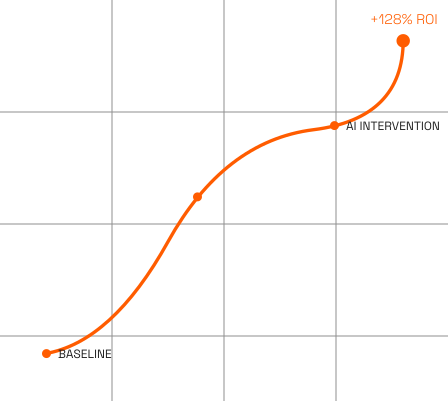
An insurance brokerage was losing enquiries to faster competitors. Inbound leads came through the website, sat in a shared inbox, and waited for a human to pick them up; average first response time: 6 hours. By that point, a third of leads had already moved on.
What our scoping found:
We assessed their operations and mapped use cases for AI, and discovered:
WE BUILT
A custom AI agent that handled the first response, collected qualification data conversationally, answered the eleven common questions, and routed ready leads directly to the right broker's calendar.
MEASURABLE IMPACT
First response dropped from 6 hours to 4 minutes. Lead conversion on inbound enquiries increased by 34%. Brokers now spend their time on qualified conversations.
If you have a workflow that follows a pattern (repetitive tasks), there's a good chance a custom AI agent can handle it better than a manual process can. We'll scope it with you, tell you what's actually buildable, and build it to run in your environment.
Schedule a CallA traditional chatbot follows predefined scripts and decision trees. A custom AI agent goes beyond scripted responses. It can qualify requests, make decisions, route or escalate conversations, and take actions across systems based on context. The difference becomes clear when conversations move outside expected paths.
No. Some clients come with a detailed AI agent brief, while others only know the operational problem they want to solve. Every engagement starts with a scoping and discovery session to define workflows, integrations, edge cases, and success metrics. Clarifying ambiguity early prevents costly changes during development.
Our autonomous AI agents integrate with most CRMs, ATS platforms, ticketing systems, calendar tools, and communication platforms. During the integration mapping phase, we identify what needs to connect, how data should flow, and what's feasible within your existing technology stack.
Timelines depend on scope and integration complexity. A well-scoped, single-use AI agent with clean integrations typically takes 6–8 weeks from scoping to deployment. Multi-agent systems or complex enterprise integrations require more time. Final timelines are confirmed after scoping, not before.
Yes. Each AI agent is trained on your data, terminology, workflows, and decision criteria. Agents trained on generic datasets behave like generic tools. Training on your specific environment is what makes the agent accurate, reliable, and operationally useful.
No mandatory platform fees and no vendor lock-in. The AI agent runs on your infrastructure, and you retain full ownership. Ongoing maintenance, retraining, or optimization is optional and only engaged if you choose to continue working with us.
Agents are tested against real-world scenarios and edge cases before handover. This eliminates most issues before production. If performance gaps appear after go-live, they are addressed. Detailed handover documentation also enables your internal team to make routine updates without external dependency.

Not every step in a workflow should be automated. Some situations are too sensitive for an AI to handle alone. Before we build, we define exactly where the agent acts autonomously, where it asks for more information, and where it shares data. An autonomous AI agent that oversteps can increase the complexity of the manual process it was supposed to replace.

Every custom AI agent we build is deployed on your own infrastructure (on-premises or in the cloud) and trained on your data, terminology, and workflows. That means no third-party platform holding your conversations, no generic responses that don't reflect how your business operates, and no ongoing dependency on an external system. The privacy stays with you. So does the personalisation.
Before handover, every agent gets tested against the actual inputs, edge cases, and failure scenarios your operation produces. Conversational AI agents that only work with clean, expected inputs aren't production-ready.

The agent runs on your infrastructure, trained on your data: no ongoing platform fees, no vendor dependency, no black box. What we build is yours; fully documented, fully transferable.
Your tool will not work as a generic Gen AI agent. We build and train AI-powered assistants (agents) based on the specifics of your business (actual data, terminology, qualification criteria, and workflows).

Phase 04
The agent gets tested against real inputs, including the messy, unexpected ones your operation actually produces. Edge cases, ambiguous inputs, escalation triggers. We don't declare it ready until it holds up under production conditions.

Phase 05
You receive a fully documented agent: how it works, what it was trained on, how to update it, and what to do when something needs to change. Your team runs it from day one without needing us in the room.
Build scalable learning and administration platforms.
 Real Estate
We assess where AI reduces support costs, improves property management, and scales real estate operations.
 Healthcare
Clinical decision support, patient flow optimization, and medical image analysis solutions.