Loading service0%

Accelerate your next phase of growth with a robust technology foundation from NeXus Labs.
We assess your technology estate to identify constraints. Then we define a digital transformation strategy to address them and provide your leadership team with an actionable roadmap. As your partner, we support execution.
In six months, your team will have a clear technology transformation roadmap, key risk solutions, and a governance model that supports long-term growth.

A clear technology transformation roadmap.

Key risk solutions identified and addressed.

A governance model that supports long-term growth.
The business has grown, but supporting technology has not kept pace, resulting in bottlenecks, manual workarounds, and integration failures. These operational symptoms are seen by leadership, but the underlying cause is the outdated technology estate.
Growth outpaced technology strategy. Systems were added to address immediate issues, not long-term integration. Now, no one fully understands the estate, risks are unassessed, and maintenance costs outweigh change costs.
During expansion or acquisition, incompatible systems and duplicated platforms are exposed, issues that were missed in the business case. The deal may be sound, but technology remains misaligned.
Unmapped technology estates create integration difficulties. What appears to be a technical issue is often caused by a lack of governance, passing technical debt between acquisitions.
Transformation projects often stall not because of poor strategy but because the technology foundation was not fully reviewed before the change began.
Past transformations sometimes added new systems without fixing deeper problems. Old issues were ignored rather than resolved, making things more complex and eroding trust in future projects.
The business has grown, but supporting technology has not kept pace, resulting in bottlenecks, manual workarounds, and integration failures. These operational symptoms are seen by leadership, but the underlying cause is the outdated technology estate.
Growth outpaced technology strategy. Systems were added to address immediate issues, not long-term integration. Now, no one fully understands the estate, risks are unassessed, and maintenance costs outweigh change costs.
During expansion or acquisition, incompatible systems and duplicated platforms are exposed, issues that were missed in the business case. The deal may be sound, but technology remains misaligned.
Unmapped technology estates create integration difficulties. What appears to be a technical issue is often caused by a lack of governance, passing technical debt between acquisitions.
Transformation projects often stall not because of poor strategy but because the technology foundation was not fully reviewed before the change began.
Past transformations sometimes added new systems without fixing deeper problems. Old issues were ignored rather than resolved, making things more complex and eroding trust in future projects.
If you skip a real assessment, technology transformation consulting only gives you a report, not a real plan. We need to know what you have, what it costs, how it connects, and what it takes to change before we make any recommendations.
[HOW WE THINK ABOUT TECHNOLOGY TRANSFORMATION CONSULTING]
Four principles shape every technology transformation consulting engagement

Before any communication or training, we conduct a change-readiness assessment. This shows how ready each stakeholder group is and how much change affected teams can handle at once. It also identifies risk factors that guide the programme's structure.
Each stakeholder group is affected differently by technology transformation. Some lose familiar processes, others gain new capabilities, and some face a steep learning curve. Change impact analysis maps these differences. We then build targeted communication, training, and support for each group.
How Your People Will Respond to It?

Most change management engagements start with stakeholder communications. We begin with a structured assessment of organisational readiness, team change capacity, and key risk factors. The communications plan is developed based on these findings.

Training, communication timing, stakeholder sequencing, and resistance management are all informed by change impact analysis. We do not use a uniform template. We design for each group's needs, knowing requirements differ by team and role.

Every technology transformation consulting engagement follows the same assessment-to-roadmap sequence:

Phase 01
We map the full technology estate: every system, integration, data flow, and governance structure. We assess these against current and projected business needs. We identify what works, what constrains growth, what carries risk, and what must change to support your future business model.

Phase 02
We work with your business and technical leadership to define future targets, including growth, operational changes, market expansion, and acquisitions. We then establish what your technology estate needs to look like to support that direction. Without this alignment, tech strategy consulting produces recommendations that do not serve the business.

(And Why Each Deliverable Exists)
01
We deliver a comprehensive map of your current technology estate (systems, integrations, data flows, governance, technical debt, and legacy risk) that is assessed against your business needs, now and in the future.
Why It Exists:
A strategy built without a full picture ends in recommendations that seem right but are undeliverable. This report grounds every decision on facts, not assumptions.
Business Impact:
Leadership and technical teams share a documented understanding of the technology estate. This view is often different from what either group believed before.
Risk Mitigation:
Surfaces legacy risks, integration dependencies, and technical debt that would have become blockers mid-program if not found early.
02
A phased, sequenced plan shows what changes, in what order, and for what reason. Dependencies, resources, risks, and criteria are mapped for each phase before the next begins.
Why It Exists:
A roadmap without sequencing is a list of things to do. Sequencing, which changes unlock which others, which risks must be retired first, and which phases can run in parallel, is what makes a roadmap executable rather than aspirational.
Business Impact:
Leadership commits to each phase with confidence, knowing that the previous phase has been prepared for success. This approach avoids discovering mid-program that the order was wrong.
Risk Mitigation:
Phase gates protect against investing in a program that reveals major constraints in phase two.
03
A documented assessment lists all identified risks and technical debt items. Each is categorized by severity, quantified by cost and operational impact, and sequenced for when it should be addressed.
Why It Exists:
Technical debt that isn't documented is deferred until a crisis. A register makes invisible risks visible. It gives leadership a basis for prioritization that isn't driven by whichever system breaks first.
Business Impact:
Technology investment decisions are made against a clear picture of risk rather than against the loudest current problem.
Risk Mitigation:
Prevents the pattern of transformation programmes that address new capability requirements while leaving unresolved the legacy risks that will eventually undermine them.
04
A defined framework for how technology decisions get made going forward, including ownership, evaluation criteria, investment governance, technical debt management, and the operating model that ensures transformation gains are maintained as the organisation continues to grow.
Why It Exists:
Organisations that complete a transformation without redesigning how technology decisions get made are likely to recreate the same constraints in the next growth cycle. Governance is what makes the transformation durable rather than a one-time correction.
Business Impact:
Future technology decisions are made consistently and with clear ownership, reducing the drift that accumulates when technology choices are made in isolation across different parts of the business.
Risk Mitigation:
Prevents the gradual reaccumulation of technical debt and the proliferation of ungoverned systems that produced the constraints the transformation was designed to resolve.
05
A detailed execution plan connecting the transformation roadmap to the required delivery capability, internal teams, Nexus, and third-party partners, with ownership, sequencing, and dependencies defined before execution begins.
Why It Exists:
The gap between a transformation strategy and a transformation outcome is almost always an execution gap (not a strategy gap). This document closes by defining who does what, in what order, with what support, before the first workstream begins.
Business Impact:
Execution begins with clarity on ownership and sequencing rather than with a strategy document and an assumption that the organisation will figure out the rest.
Risk Mitigation:
Prevents the most common transformation failure mode; a credible strategy that stalls because execution ownership was never clearly defined.
01
We provide a detailed technology assessment report that highlights all major legacy risks and technical debt. Both business and technical leaders get a clear summary of the current state, creating a shared starting point for future transformation decisions.
02
We deliver a step-by-step transformation roadmap and a clear governance model. The first phase starts with defined roles, responsibilities, and clear ways to track progress from the beginning.
03
After the first transformation phase is finished, we measure the changes against the starting point. We review what worked and use those lessons to plan the next phase, making sure future steps are based on real results. The governance model is tested and confirmed by how well it works in practice.

The business has grown, but supporting systems have not kept pace. Processes that once worked now cause friction, manual workarounds, and integration failures, resulting in operational issues. Digital transformation consulting that begins with a thorough assessment provides leadership with a clear understanding of required changes, their sequence, and the resources needed.

Identifying incompatible systems, integration challenges, and legacy risks after a deal is finalized is more costly than addressing them beforehand. Engaging technology transformation consulting before a major strategic move equips leadership with the insights needed for informed decisions and a clear integration roadmap, established before inheriting complexity.
Legacy systems present risks when original developers have departed, and documentation is incomplete. Without a full understanding of dependencies, every change is risky. Cloud transformation consulting and a legacy modernisation strategy that maps dependencies in advance convert unmanaged risk into a structured, controlled program.

Previous transformation efforts may have introduced new systems without resolving underlying issues, allowing technical debt to persist. Advisors who start with a candid assessment of what remains, rather than assuming a fresh start, develop strategies that the organisation can realistically implement.
We deliver specialized AI consulting across high-impact sectors:
 Industrial & Manufacturing
Predictive maintenance, quality control automation, and supply chain intelligence systems.
 Engineering & High-Tech
Enhancing innovation, performance, and efficiency through AI-driven engineering and automation.

Two years earlier, a mid-size regional bank began a core banking modernization program. After 18 months and a depleted budget, the program was abandoned due to unmanageable integration complexity between the new core system and 14 downstream applications.
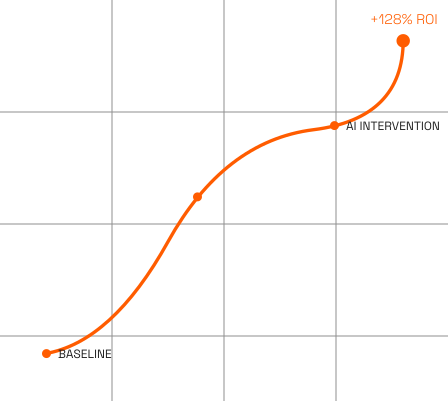
Two years earlier, a mid-size regional bank began a core banking modernization program. After 18 months and a depleted budget, the program was abandoned due to unmanageable integration complexity between the new core system and 14 downstream applications. The bank returned to its legacy system, resulting in two years of deferred investment and reduced confidence in large-scale technology change.
What our technology estate assessment found:
We assessed their operations and mapped use cases for AI, and discovered:
WE DEVELOPED
A transformation roadmap that prioritized middleware replacements and data model reconciliation in phases one and two, before starting core banking modernization in phase three. Although the program duration increased, the risk profile improved significantly.
MEASURABLE IMPACT
Phases one and two finished on time and within budget. Core banking modernization began phase three with integration dependencies and data model constraints resolved. The program, which previously failed, now had a solid foundation. The assessment that identified these issues cost less than one percent of the failed program's total cost.
We assess your technology landscape before creating technology transformation roadmaps to deliver the right technology that accelerates your business growth.
Book a Technology AssessmentIT consulting solves defined technology challenges. Technology transformation consulting holistically assesses the technology estate and its fit to the business. It introduces essential changes in decision-making, governance, and architecture, with a comprehensive transformation roadmap as the main deliverable.
Both services are provided. NeXus Transform develops a strategy and a roadmap; Nexus Build and Nexus AI handle execution, including software development, product design, and AI deployment. Clients with internal capabilities may implement the roadmap independently. Consulting and execution are linked but not interdependent.
Roadmap and estate assessment take 4–8 weeks. Full consulting, including governance and execution planning, extends up to six months. Execution timelines depend on roadmap sequencing. All timelines are confirmed after the initial assessment conversation.
AI transformation focuses on integrating AI into workflows, with change management and adoption to ensure successful deployment. Technology transformation evaluates the whole technology estate, with AI as one possible component. Some clients use both services or start with a technology strategy before pursuing AI initiatives.
Previous transformation efforts often fail due to incomplete assessment, poor sequencing, or weak governance. Each engagement starts by evaluating the current state and reviewing prior efforts, never with a blank slate.
A governance model defines future decision-making—ownership, criteria, debt, and investment. Without it, change is short-lived. Effective governance ensures sustained success and avoids repeating past constraints.
Yes. Most engagements collaborate with the client's IT team during assessment, roadmap, and planning. Consulting services complement, not replace, internal teams. We deliver technology transformation (from consulting to execution) at NeXus Labs. Nexus Build and Nexus AI provide extra execution resources as needed, aligned with strategy.

Our IT change management services treat resistance as something to understand and respond to. We do not simply repeat the original message louder.

Operational change is proven in the first 90 days after deployment. We measure adoption using workflow shifts, eliminated workarounds, and usage rates. This ensures your organization captures the full value of its investment.
Some consultancies deliver only a change strategy for clients to implement. We both design and execute the programme. This includes stakeholder sessions, training, communications, resistance management, and adoption tracking. CTOs and programme directors do not have to manage the change workstream themselves.

When the transformation roadmap calls for new software, AI, or product development, Nexus Build and Nexus AI operate under a single strategic direction, alongside Digital Transformation Consulting from NeXus Labs. If you hand off to a different execution partner, a gap opens that loses transformation value.
Phase 03
We assess technical debt and legacy risk across the estate. We identify the systems, integrations, and architectural decisions that create constraints today and will create greater ones as the business scales. We categorize, quantify, and sequence risks so leadership knows what must be resolved and in what order before other changes proceed.

Phase 04
We turn findings into a sequenced digital transformation roadmap. It is phased by dependency, resourced by capability, and risk-weighted so you can commit to each stage with confidence before starting the next. The roadmap shows what changes will occur, the cost, and what the organization will look like at the end of each phase.

Phase 05
We define the technology governance structure that ensures consistent decisions. This includes technology ownership, evaluation of new systems, and ongoing management of technical debt. It prevents the recreation of constraints in the next growth cycle. Technology transformation services that skip governance offer only a one-time fix.

Phase 06
When the roadmap requires software development, AI deployment, product design, or infrastructure work, we connect strategy to execution through Nexus Build and Nexus AI where relevant. If preferred, we use the client's teams and partners instead. Planning the execution is part of the consulting engagement, not a separate conversation after the roadmap is delivered.
Build scalable learning and administration platforms.
 Real Estate
We assess where AI reduces support costs, improves property management, and scales real estate operations.
 Healthcare
Clinical decision support, patient flow optimization, and medical image analysis solutions.