Loading service0%

Remove what slows your business down before you build, automate, or scale anything on top of it.
We look at how your operations really work, find where time and effort are wasted, and redesign your team's workflows. Business process optimization to align your technology, automation, and growth has a strong foundation.
In six months, your team will have a clear technology transformation roadmap, key risk solutions, and a governance model that supports long-term growth.

A clear technology transformation roadmap.

Key risk solutions identified and addressed.

A governance model that supports long-term growth.
The team is working hard. Output is not keeping pace. The same tasks take longer than they should. Approvals sit waiting. Handoffs between teams create delays nobody owns. Everyone is busy, but the work moves slowly.
Nobody designed the process. It grew. Each workaround is built on the previous one until the current way of working looks nothing like what anyone originally intended — and nobody has mapped it end to end.
A new system is live. Adoption is low. Teams use the technology in ways it was not designed for, or ignore it entirely and stick to the old method. The technology works. The process around it does not.
Someone layered the technology onto a process that was already broken. Automation speeds up what was already happening, including the inefficient parts. Business process optimization has to happen before the technology arrives, not after it fails to produce the expected results.
The team is working hard. Output is not keeping pace. The same tasks take longer than they should. Approvals sit waiting. Handoffs between teams create delays nobody owns. Everyone is busy, but the work moves slowly.
Nobody designed the process. It grew. Each workaround is built on the previous one until the current way of working looks nothing like what anyone originally intended — and nobody has mapped it end to end.
A new system is live. Adoption is low. Teams use the technology in ways it was not designed for, or ignore it entirely and stick to the old method. The technology works. The process around it does not.
Someone layered the technology onto a process that was already broken. Automation speeds up what was already happening, including the inefficient parts. Business process optimization has to happen before the technology arrives, not after it fails to produce the expected results.
The result is operations that cost more than necessary, technology that doesn't deliver as expected because the underlying processes haven't changed, and teams stuck doing work that better processes could remove.
Even worse, when your business grows or enters a new market, weak processes can break down just when you need them most. What worked before may not handle the demands of the next stage.
[HOW WE THINK ABOUT TECHNOLOGY TRANSFORMATION CONSULTING]
Process optimization services work best when they start with how work really happens, not just what's written in a manual. Before we redesign anything, we take time to fully understand the current steps, handoffs, workarounds, delays, and the informal decisions teams make that aren't in the official process. Four principles shape every business process optimization engagement:

Every organisation has two versions of its processes: the one in the documentation and the one people actually follow. In lean process optimization, we map what is actually happening on the ground with the people doing the work before forming any view of what needs to change.

Steps that add no value, unnecessary approvals, and outdated handoffs all slow things down and increase costs. We start continuous process improvement by removing what isn't needed, not by adding new tools or technology to a broken process.
Where Your Process Is Slowing Your Business Down?

Our end-to-end process optimization work starts with the people running the process, which means mapping every step, every workaround, every informal decision, before drawing any conclusions about what needs to change. What we find almost always differs from what the documentation says.

The most common mistake in IT process optimization is introducing automation into a process that still contains steps, approvals, and handoffs that should not exist. We identify and remove those first, so the technology accelerates a clean process rather than locking a broken one in permanently.

Every workflow optimization services engagement follows the same assessment-to-implementation sequence:

Phase 01
We review your current processes to see how well they're defined, how consistently teams follow them, how much they vary across locations, and if they're ready for automation or growth. This process maturity assessment indicates whether a process needs minor changes or a full rebuild.

Phase 02
We map each process from start to finish, working with the people who do the work. We document every step, decision, handoff, workaround, and exception. This gives us a true starting point and often reveals things even leaders didn't know were happening.

Phase 03
(And Why Each Deliverable Exists)
01
A documented assessment of how well-defined, consistently followed, and scalable each process in scope is, with clear identification of what requires refinement, rebuilding, or is ready for automation.
Why It Exists:
Understanding current maturity prevents redesigns that are either too advanced to implement or too conservative to drive improvement. The assessment informs all subsequent decisions.
Business Impact:
Redesign efforts focus on areas with the greatest need, rather than applying changes uniformly.
Risk Mitigation:
Identifies high-risk processes before issues arise and avoids unnecessary effort on processes already performing well.
02
End-to-end maps of each process in scope as it operates today, documenting every step, decision point, handoff, workaround, and exception. This serves as the baseline for all redesign decisions.
Why It Exists:
Accurate mapping is essential for improvement. Most organisations rely on incomplete or outdated process views. These maps provide evidence-based clarity.
Business Impact:
All stakeholders work from a single, accurate view of process flow, which is essential for effective redesign.
Risk Mitigation:
Reveals informal workarounds and undocumented exceptions that could undermine redesign efforts based solely on official documentation.
03
Redesigned processes are documented with waste removed, steps restructured, handoffs clarified, and exceptions addressed, at a level of detail that enables consistent implementation.
Why It Exists:
Effective redesign requires actionable documentation. Detailed documentation enables teams to follow the new process and supports ongoing audit and improvement.
Business Impact:
Teams follow a consistent, optimised process instead of relying on individual interpretations.
Risk Mitigation:
Reduces process variation, which lowers quality inconsistencies, rework, and operational risk.
04
A clear assessment of which processes and steps are ready for automation or AI deployment, which require further optimisation, and which should remain human-led, with documented reasoning for each recommendation.
Why It Exists:
Automating before optimising embeds inefficiencies. This report guides technology and operations teams on where automation adds value and where it may worsen existing issues.
Business Impact:
Technology investments target processes that are ready, delivering projected productivity gains rather than disappointing returns.
Risk Mitigation:
Avoids the cost and disruption of automating processes that later require redesign.
05
Defines performance measures, targets, and monitoring methods to determine if optimised processes are delivering as intended, and provides early indicators for process owners to address performance issues promptly.
Why It Exists:
The business process optimization procedure ensures accountability for process changes. This framework makes impact visible, builds leadership confidence, and supports ongoing improvement.
Business Impact:
Process performance is actively managed with clear measures to confirm the optimised process is effective under real conditions.
Risk Mitigation:
Early indicators reveal performance issues in time to address them before they escalate.
06
Provides ongoing support during implementation, addressing edge cases, adjusting designs as needed, and tracking performance against initial benchmarks. A monitoring report documents changes and performance outcomes.
Why It Exists:
Teams that implement redesigns without support often struggle to achieve the intended results. Active support addresses real-world challenges and ensures alignment with the new process.
Business Impact:
The new process fully replaces the old one, preventing reversion and ensuring sustained improvement.
Risk Mitigation:
Edge cases are resolved during implementation, reducing the risk of teams reverting to previous processes.
01
Process maturity assessment complete. All in-scope processes are mapped as they actually run. Waste and bottlenecks identified. Redesign priorities agreed with operations leadership before any changes are made.
02
Redesigned processes, documented, and implemented with the teams doing the work. Automation readiness assessment complete. Performance benchmarks active and showing early results.
03
Optimised processes running consistently across all teams and locations. Performance measures showing the impact against the baseline. Automation and technology deployment are underway on processes confirmed ready for it.

As businesses grow, processes may evolve without sufficient planning, leading to bottlenecks, inconsistency, and inefficiency. Business process optimization helps leaders identify priorities, sequence improvements, and sustain progress.

Automation accelerates both effective and ineffective processes. Improving processes before automation ensures technology enhances what works. Skipping lean process optimisation can worsen existing issues and complicate future fixes.

The system is operational, but adoption is low because processes do not align with actual workflows. We redesign processes through process improvement consulting to ensure technology is used as intended.

When locations perform the same work differently, quality declines, and training becomes inefficient. End-to-end process optimization maps, redesigns, and standardizes processes so all teams operate from a common baseline, enabling effective measurement, improvement, and scaling.
We deliver specialized AI consulting across high-impact sectors:
 Industrial & Manufacturing
Predictive maintenance, quality control automation, and supply chain intelligence systems.
 Engineering & High-Tech
Enhancing innovation, performance, and efficiency through AI-driven engineering and automation.

A mid-sized financial services firm initiated a loan processing automation project. However, a process maturity assessment revealed a critical issue: the workflow contained 11 approval steps, four of which were obsolete and persisted from an organizational structure revised two years earlier.
A mid-sized financial services firm initiated a loan processing automation project. However, a process maturity assessment revealed a critical issue: the workflow contained 11 approval steps, four of which were obsolete and persisted from an organizational structure revised two years earlier. These redundant steps had not been eliminated. Automating the existing process would have merely expedited these unnecessary approvals rather than removing them.
Here's what the process mapping revealed:
We assessed their operations and mapped use cases for AI, and discovered:
FIRST, WE REDESIGNED
The process by removing unnecessary approvals, changing intake to collect all needed data up front, and making the workflow consistent before adding automation. We then planned the automation based on this improved process.
MEASURABLE IMPACT
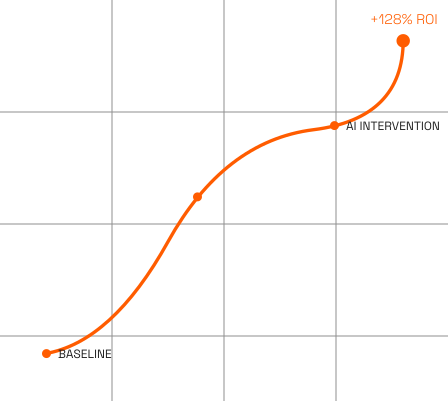
Loan processing time was reduced by 67%, decreasing from an average of fourteen days to fewer than five. As a result of the process redesign, the automation project scope was reduced by 40%, leading to lower costs and more rapid delivery of results than initially anticipated.
Call us to assess your operations. We will map current workflows, identify inefficiencies, and redesign processes for consistent team adoption and reliable technology integration.
Book a Process AssessmentTechnology transformation consulting focuses on which systems need to change and in what order. Business process optimization, on the other hand, redesigns the workflows that those systems support. Technology works better when it runs on optimized processes, rather than being added to ones that are already broken. You can also choose process optimization as a standalone service, without a larger transformation program.
A process maturity assessment looks at how clear, consistent, and scalable your current processes are. It shows whether a process needs to be improved or completely rebuilt, and highlights which ones have the most risk. We do this assessment before any redesign, so we focus our efforts where they matter most.
Process optimization should come first. Once you automate a process, it becomes faster but also harder to change. If you optimize before automating, the technology speeds up a process that already works well. If you automate before optimizing, you risk making any inefficiencies permanent and more costly to fix later.
We work directly with your team, observing, interviewing, and documenting while normal work continues. Process mapping does not mean taking teams offline. It just takes time with the right people and good questions. Usually, the team already knows most of what we find. It just hasn't been written down or solved yet.
A process maturity assessment and initial mapping typically run for three to four weeks. Full redesign, implementation support, and post-optimisation monitoring run three to six months, depending on scope and complexity. We confirm timelines after the assessment, not before.
We design the new process together with your team, not just for them. We help with implementation, handle unusual situations as they come up, and track results against the goals we set at the beginning. When your team helps design a process, they trust it, and that trust is what keeps improvements going.
Process optimization services improve workflows by removing waste, clarifying steps, and making results more consistent. After that, process automation uses technology to handle the steps that are ready for it. Optimization comes first. Automation follows, but only for the steps that make sense.

A process that only works on paper won't be followed if it doesn't match how your team really works. We design processes together with your team, so they understand and trust the changes. That's what makes improvements last.
If you can't measure what changed, you can't prove the value or keep improving. We provide process improvement consulting to set clear performance goals before making changes and track results after, so you can see the real impact.
Lean thinking is best for high-volume, repetitive work. Agile design fits processes that need to adapt as things change. When a process is too layered, starting from scratch is often faster. We pick the method that suits your needs.

When a team gets a redesign and tries to implement it alone, it rarely works as planned. We stay involved during implementation, adjust the design as needed, and make sure the new process fully replaces the old one.
We review the mapped processes to identify where value is lost in time, effort, errors, and quality. This includes steps that add nothing, approvals that only cause delays, handoffs that lose information, and rework caused by earlier mistakes. Lean process optimization at this stage helps us set clear priorities for improvement.

Phase 04
Before finalizing the redesign, we check which steps are ready for automation or AI and which still require human involvement. IT process optimization prevents the costly mistake of automating a process before it's improved, which can make inefficiencies permanent.

Phase 05
We redesign processes by removing what's unnecessary, restructuring what matters, and standardizing the results so everyone does the work the same way. We always work together with process owners and the people doing the work.

Phase 06
We set performance measures to show if the new process is working—like output quality, cycle time, error rate, and cost per transaction. We also track early signs of improvement or problems before they become obvious.

Phase 07
We help teams put the new processes in place, work with them through any issues that come up, and make adjustments as needed. After rollout, we track results against the original benchmarks.
Build scalable learning and administration platforms.
 Real Estate
We assess where AI reduces support costs, improves property management, and scales real estate operations.
 Healthcare
Clinical decision support, patient flow optimization, and medical image analysis solutions.