Loading service0%

Structured annual maintenance to sustain software performance to the intended standard.
An Annual Maintenance Contract (AMC) from NeXus Build provides ongoing support for updates, bug fixes, security, and feature enhancements, keeping your product up to date and at peak performance.
During the first year, we maintain your codebase, provide timely updates, fix issues before they cause problems, and offer dependable support.

We maintain your codebase with timely updates.

Fix issues before they cause problems.

Dependable support when you need it.
The product had a strong launch. But six months in, a third-party integration failed. Soon after, a browser update broke a UI component, and then a key dependency became outdated. Each issue on its own is manageable, but together they pile up faster than the team can handle while managing their other tasks.
As these problems add up, unplanned maintenance starts to compete with planned development. Fixing bugs on the fly disrupts sprints, and patches made in a hurry often miss proper testing. The product keeps working, but it never feels fully stable. Meanwhile, technical debt quietly grows with every delayed update.
Minor feature requests stay in the backlog for months because there is no set process to handle them. The product still works, but it is not keeping up with user requests or business needs.
There is no set agreement for ongoing work. Every improvement needs a new discussion about scope, a new quote, and a new project start. Because starting small tasks informally takes extra effort, they often do not get done. It is not a lack of priority, but a lack of structure that holds things back.
The product had a strong launch. But six months in, a third-party integration failed. Soon after, a browser update broke a UI component, and then a key dependency became outdated. Each issue on its own is manageable, but together they pile up faster than the team can handle while managing their other tasks.
As these problems add up, unplanned maintenance starts to compete with planned development. Fixing bugs on the fly disrupts sprints, and patches made in a hurry often miss proper testing. The product keeps working, but it never feels fully stable. Meanwhile, technical debt quietly grows with every delayed update.
Minor feature requests stay in the backlog for months because there is no set process to handle them. The product still works, but it is not keeping up with user requests or business needs.
There is no set agreement for ongoing work. Every improvement needs a new discussion about scope, a new quote, and a new project start. Because starting small tasks informally takes extra effort, they often do not get done. It is not a lack of priority, but a lack of structure that holds things back.
Over time, your product may fall below its original standard due to missed updates, unaddressed security risks, and unresolved minor issues, rather than a single major failure.
A greater risk is that your product could retain known security issues that have already been resolved elsewhere, simply because regular maintenance was not performed in your environment.
[HOW OUR AMC WORKS]
AMC services are most effective when the scope, tasks, and expectations are clearly defined before challenges arise. Waiting to establish a contract until after an issue occurs is often too late. Four principles shape every application maintenance services engagement:

We consistently schedule updates, security patches, performance assessments, and database backups, regardless of current issues. Reactive support handles problems outside the regular schedule, ensuring ongoing product stability.

We define the AMC scope at the contract start, including hours, response times, feature additions, and extra work. This clarity ensures efficient handling of requests, prevents confusion about coverage or cost, and provides predictable support.
Maintenance Coverage

A SaaS product with active third-party integrations requires a different maintenance approach than an internal tool with a stable codebase. As an AMC Service Provider, we begin each engagement by reviewing your product, dependencies, update schedule, security risks, and enhancement backlog. This ensures the contract addresses your product’s actual requirements.

We separate planned maintenance hours from urgent support requests. Break-fix tickets are managed independently, so high support volume does not delay scheduled updates. This approach maintains product stability rather than just reacting to issues.

From scope definition to ongoing reporting — every phase is structured and predictable.

Phase 01
We review your product, understand current state, and define the maintenance scope.

Phase 02
We finalise SLAs, response times, and coverage terms before work begins.
Phase 03
Recurring maintenance tasks are structured and scheduled from day one.
(What's Usually Part of the Deliverables in an Annual Maintenance Contract?)
01
A documented contract specifies hours allocation, maintenance schedule, ticket response times, feature addition limits, escalation paths, and out-of-contract thresholds. All terms are agreed upon before the first request.
Why It Exists:
Maintenance without a defined scope creates ambiguity about coverage, costs, and decision-makers. The AMC scope document ensures both sides know exactly what is included, protecting the client from unexpected expenses and providing a clear reference for every request.
Business Impact:
Both teams share a clear understanding of what is included, eliminating negotiation overhead for small tasks and making maintenance costs predictable.
Risk Mitigation:
Prevents the scope creep that turns a maintenance contract into an informal development engagement with unclear cost implications.
02
We perform planned maintenance on the agreed schedule, update dependencies, apply security patches, manage framework versions, verify database backups, and review performance. All activities are documented and reported each cycle.
Why It Exists:
Preventive maintenance services applied on a schedule catch issues that reactive support misses, dependency vulnerabilities, deprecated integrations, and gradual performance degradation.
Business Impact:
The product stays up to date with its dependencies and security posture without requiring your team to manually track and apply every update.
Risk Mitigation:
Scheduled security patching addresses known vulnerabilities on a defined timeline, removing the exposure window between vulnerability publication and unscheduled patching.
03
We provide ticket-based support for bugs, integration issues, and unexpected behavior. Each ticket is prioritized by severity, resolved within contract response times, and documented for reporting.
Why It Exists:
Products in production encounter issues that scheduled maintenance doesn't prevent. Structured break-fix support means those issues are resolved within a defined response commitment, not informally, at unpredictable cost, or in competition with other work.
Business Impact:
Issues are resolved on a predictable timeline, allowing your team to plan effectively. Unlike informal support, where urgency dictates priority and cost, this approach ensures consistent, predictable outcomes.
Risk Mitigation:
Severity-tiered response times ensure critical issues receive the fastest response without every ticket being treated equally urgently.
04
We deliver minor enhancements, UI adjustments, workflow changes, and integration updates within the AMC scope. These are estimated, approved, and completed without requiring a new agreement for each request.
Why It Exists:
Products that can't absorb minor improvements without a formal project for each one fall behind what users and the business need from them. In-contract feature additions remove that friction for work within the defined scope.
Business Impact:
The product improves incrementally throughout the contract year without the overhead of starting a new engagement for each small change.
Risk Mitigation:
The defined scope limit means both sides know when a request moves from maintenance territory to development territory, before work begins, not after.
05
Monthly reports detail hours used, tickets resolved by severity, scheduled maintenance completed, and enhancements delivered. We also conduct an annual review to ensure the contract scope aligns with the product.
Why It Exists:
A maintenance contract that runs invisibly gives the client no basis for evaluating whether it's working. Regular reporting provides visibility into what's being done, what it's costing against the contract, and whether the coverage is proportionate to the product's needs.
Business Impact:
Your team knows exactly what has been maintained, resolved, and improved, and has the data needed to assess whether the AMC scope should be adjusted as the product evolves.
Risk Mitigation:
Annual contract reviews prevent the common pattern of a product outgrowing its maintenance scope without either side noticing until a significant gap appears.
01
AMC scope agreed. Maintenance calendar established. First scheduled maintenance cycle complete. Break-fix support is active with defined response times.
02
First quarter of scheduled maintenance delivered and reported. Enhancement backlog within AMC scope assessed and actioned. Product dependency stack is current.
03
Full year of scheduled maintenance on record. Security posture maintained throughout. Enhancement scope consumed and documented. Annual review complete — contract scope updated to reflect where the product is now.
Teams that shipped with Nexus and want continuous, structured post-launch maintenance.

We design the AMC around your actual product — not a generic template.
We deliver specialized AI consulting across high-impact sectors:
 Industrial & Manufacturing
Predictive maintenance, quality control automation, and supply chain intelligence systems.
 Engineering & High-Tech
Enhancing innovation, performance, and efficiency through AI-driven engineering and automation.

A healthcare software company had been running its patient communication platform for two years after launch without a formal maintenance structure. Development happened on a project basis. Maintenance happened only when something broke.
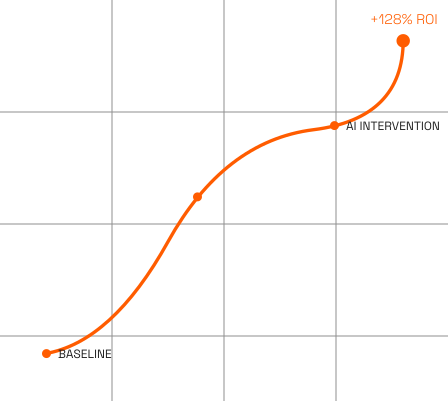
A healthcare software company had been running its patient communication platform for two years after launch without a formal maintenance structure. Development happened on a project basis. Maintenance happened only when something broke. Scheduled dependency reviews didn't happen at all.
What the review found:
Six months into their AMC with NeXus, a quarterly dependency review identified:
WITHIN THE AMC, WE SCOPED AND DELIVERED
The library replacement over three weeks, ensuring it was tested, documented, and deployed before the compliance window closed.
MEASURABLE IMPACT
The platform stayed compliant without requiring an emergency fix, avoided audit risks, and remained within the terms of the contract. The scheduled review that caught the issue cost far less than fixing a compliance problem later. As the client said at the annual review: "We didn't know what we were missing until the first quarterly report showed us what had been done."
Bring us the product. We'll look at your codebase, dependencies, and feature backlog, then outline exactly what an AMC for your product should cover.
Book a Maintenance ReviewAMC services focus on managing application codebases, dependencies, security updates, break-fix support, and minor enhancements. This work is done on a scheduled, ticket-based system. Managed IT Services, on the other hand, takes care of infrastructure, including continuous monitoring, DevOps, databases, and round-the-clock operations. If your product needs complex infrastructure, Managed Services is the right choice. If you only need ongoing application-level support and do not require 24/7 infrastructure, AMC is a better fit. Some clients choose to use both models with NeXus Build.
No. We support products built by any vendor. Each new AMC engagement begins with a product review to assess the codebase, dependencies, and integration architecture before finalizing the contract scope.
Feature additions under AMC are defined at the start of the contract. These usually include minor UI changes, workflow tweaks, configuration updates, and simple integration adjustments, all within the agreed hours. If you request something outside this scope, we will give you a separate estimate before starting the work. We document these boundaries so you know what to expect before making requests.
We provide monthly reports to track how you use your allocated hours. If you need more work than your monthly allocation covers, we will scope and get approval for the extra work in advance. This way, there are no informal promises and no surprise invoices.
We apply security patches during scheduled maintenance, not on an ad hoc basis. Each cycle, we review and patch any known vulnerabilities in the dependency stack. If there is a critical threat, we treat it as a break-fix issue and handle it outside of regular maintenance.
Infrastructure monitoring and operations are part of Managed Services, not AMC. If you need support for both your application and infrastructure, we can include both in your NeXus Build plan, each with its own defined scope.
During the annual review, we check if the AMC still fits your product, if the hour allocations match your usage, and if the enhancements meet your needs. We also see if any product changes require updates to the contract. After the review, you either renew or get an updated contract that matches your current needs.
Yes, AMC can cover AI agents, models, and pipelines from NeXus AI. This includes bug fixes, dependency updates, minor prompt or workflow tweaks, and integration support. Major work, like retraining or building new agents, is scoped separately.

If maintenance only addresses operational continuity and not codebase structure, future development becomes more complex. We ensure every update, patch, and fix meets original standards and is documented, tested, and ready for future teams.

Separating maintenance from minor feature updates adds unnecessary complexity. Our AMC includes limited feature enhancements, allowing incremental product improvements without new contracts for each change.
Seven core operation categories covered We review and update third-party dependencies, frameworks, and vulnerability patches on a defined schedule. This preventive maintenance service identifies risks early, reducing costs compared to addressing issues after they arise under one structured maintenance contract.

Minor improvements such as UI modifications, workflow enhancements, integration updates, and configuration adjustments are included in the AMC up to a defined threshold. Requests within this scope proceed without additional contracts; those exceeding the threshold are scoped separately, starting from the AMC foundation.

Phase 04
Reactive bug fixes and incident response handled within agreed SLA windows.

Phase 05
Minor enhancements and feature additions managed within the existing contract.

Phase 06
Regular performance reports and contract review meetings to ensure alignment.
Build scalable learning and administration platforms.
 Real Estate
We assess where AI reduces support costs, improves property management, and scales real estate operations.
 Healthcare
Clinical decision support, patient flow optimization, and medical image analysis solutions.