Loading service0%

Transform your technology strategy into an actionable, fundable plan for your organisation.
We turn your technology strategy into a clear, step-by-step plan, a technology roadmap. We prioritise projects, map out what depends on what, plan resources, and connect investments to business results. This helps leaders focus on the right projects at the right time.
Within a month, you'll get a 12-month technology roadmap that fits your business goals, a clear resource and budget plan for your finance team, and a review process to keep everything current as your business evolves.

A 12-month technology roadmap that fits your business goals.

A clear resource and budget plan for your finance team.

A review process to keep everything current as your business evolves.
Overview
We turn your technology strategy into a clear, step-by-step plan, a technology roadmap. We prioritise projects, map out what depends on what, plan resources, and connect investments to business results. This helps leaders focus on the right projects at the right time.
Within a month, you'll get a 12-month technology roadmap that fits your business goals, a clear resource and budget plan for your finance team, and a review process to keep everything current as your business evolves.
The transformation strategy is set, and leadership has agreed on the direction. Yet a year later, the same initiatives are still only in the planning phase. No one has committed resources, organized the work, or figured out which tasks can begin and which need to wait.
A strategy document explains the organisation's direction, but it doesn't tell anyone what to do next. Without a roadmap that sets the order of decisions, sorts out dependencies, and links each initiative to a budget and resource plan, the strategy stays on paper, agreed in principle but not put into action.
Leadership signs off on technology investments but doesn't see the cost of each phase, its dependencies, or what the business will look like at the end. Every budget discussion starts from zero because there's no plan to refer to.
When there's no roadmap, technology investment decisions are made reactively, often just to fix the most urgent problem instead of following a clear direction. This leads to a patchwork of individual choices rather than a unified plan, and to a budget that grows without a clear goal.
The transformation strategy is set, and leadership has agreed on the direction. Yet a year later, the same initiatives are still only in the planning phase. No one has committed resources, organized the work, or figured out which tasks can begin and which need to wait.
A strategy document explains the organisation's direction, but it doesn't tell anyone what to do next. Without a roadmap that sets the order of decisions, sorts out dependencies, and links each initiative to a budget and resource plan, the strategy stays on paper, agreed in principle but not put into action.
Leadership signs off on technology investments but doesn't see the cost of each phase, its dependencies, or what the business will look like at the end. Every budget discussion starts from zero because there's no plan to refer to.
When there's no roadmap, technology investment decisions are made reactively, often just to fix the most urgent problem instead of following a clear direction. This leads to a patchwork of individual choices rather than a unified plan, and to a budget that grows without a clear goal.
The result is often a strategy that gets ignored while the organisation continues to use outdated technology. This usually happens not because the strategy was wrong, but because no one turned it into a practical plan.
It can get worse: projects may start in the wrong order, run into problems, and stall. This wastes money and makes leaders lose confidence, without delivering the results they wanted.
[HOW WE THINK ABOUT TECHNOLOGY ROADMAP SERVICES]
Our technology roadmap services turn your strategy into real action. Before planning, we learn what your business needs, what technology you already have, and what factors will affect the order of work. Four principles shape every strategic IT planning engagement:

Each project on the roadmap is chosen to help your business achieve a clear goal, such as growth, improved operations, or lower risk. If the technology transformation roadmap is based on tech preferences rather than business needs, it's hard to demonstrate value or secure leadership support.

Roadmaps often fail not because the projects are wrong, but because they aren't planned in the right order. If a project can't start until something else is finished, that's a key detail. In our technology roadmap services, we always map these dependencies before deciding the order.
Your Transformation Strategy

Every organisation wants to move faster than its dependencies allow. Our IT modernization services make those dependencies clear before setting the order, so the roadmap shows what your team can actually deliver, not just what you hope to do if everything goes perfectly.

A technology project without a business outcome is just a cost. Every phase of our roadmap links what gets built or changed to the business result it should deliver. This makes the roadmap fundable and the investment easy to justify.

If resource and budget planning are left for later, the plan may look good on paper, but can't be delivered when it's time to staff and fund it. We define what each phase needs before finalising the roadmap, so leaders approve a plan that the organisation can actually support.
Every technology roadmap service engagement follows the same alignment-to-execution sequence:

Phase 01
We review your current technology setup against your transformation strategy. We look at what's in place, what's already committed, what risks exist, and the gaps between where you are now and where you want to be. This is the starting point for every roadmap decision.

Phase 02
We work with business and technology leadership to confirm the outcomes the roadmap needs to deliver, growth targets, operational improvements, risk retirements, and the business milestones that determine what needs to be in place and when. Every initiative we include on the roadmap connects back to one of these outcomes.

(And Why Each Deliverable Exists)
01
A documented review of the current technology estate compared to the transformation strategy, detailing what is in place, what is committed, associated risks, and gaps between the current and target states.
Why It Exists:
A roadmap requires an accurate current state assessment to avoid relying on incorrect assumptions. This report ensures sequencing decisions are based on the organisation's actual assets, not on assumptions.
Business Impact:
Each initiative starts from a confirmed baseline, ensuring timelines and resource estimates are realistic.
Risk Mitigation:
Identifies gaps and legacy risks early, preventing potential programme blockers.
02
A structured assessment of each initiative, scored by business impact, dependency readiness, and resource availability. Trade-offs between competing priorities are made explicit before sequencing.
Why It Exists:
Attempting to execute all initiatives at once leads to poor results. Explicit prioritisation provides leadership with a clear basis for sequencing, resulting in a programme that can be staffed and funded effectively.
Business Impact:
Leadership commits to a sequence with full visibility into each prioritisation decision, enabling faster commitment and reducing mid-programme re-prioritisations.
Risk Mitigation:
Prevents initiatives from competing for the same resources and stalling, which can waste budget without delivering outcomes.
03
A phased, sequenced plan for all initiatives, with business outcomes, dependencies, resource requirements, budget estimates, and success criteria defined for each phase before proceeding to the next.
Why It Exists:
A strategy defines direction, while a roadmap provides the steps, order, resources, and resolved dependencies needed to execute. Without a roadmap, the strategy remains theoretical.
Business Impact:
All teams work from a unified plan, making decisions about starting, deferring, and funding initiatives based on a shared reference.
Risk Mitigation:
Phase gates prevent full resource commitment before dependencies are resolved, reducing the risk of stalled progress in later phases.
04
A phase-by-phase breakdown of each initiative's requirements, including internal capacity, external resources, capital expenditure, and procurement lead times, structured for finance and programme leadership to plan and approve.
Why It Exists:
Separating the roadmap from the resource plan can result in unfeasible commitments. Integrating resource and budget planning into IT transformation services ensures that leadership commits to an executable plan.
Business Impact:
Finance and technology leadership use consistent data, accelerating approvals and reducing friction between technology goals and financial constraints.
Risk Mitigation:
Identifies resource constraints early, allowing for timeline adjustments or additional investment before programme execution begins.
05
A documented structure outlining how roadmap decisions are made, who owns updates, review triggers, how priority shifts are managed, and the process for adding or deferring initiatives between review cycles.
Why It Exists:
Without governance, a roadmap becomes static. Defined processes for updates ensure the roadmap remains relevant as priorities shift.
Business Impact:
The organisation makes consistent roadmap decisions with clear ownership, reducing time spent revisiting priorities.
Risk Mitigation:
Prevents informal priority changes from distorting the roadmap and ensures it accurately reflects organisational activities.
06
A structured update of the roadmap at each review cycle, documenting delivered items, changes in the business or technology landscape, updated priorities, and the revised plan for the next period.
Why It Exists:
Annual reviews leave the roadmap outdated in a changing environment. Regular review cycles keep the plan aligned with business direction, ensuring it remains a useful planning tool.
Business Impact:
Leadership bases investment and resourcing decisions on a current plan, reducing wasted investment in outdated initiatives.
Risk Mitigation:
Identifies misalignments between the roadmap and business direction, allowing adjustments before resources are committed to the wrong sequence.
01
We complete the current state assessment and establish a clear baseline. We confirm business goals and growth targets, then map dependencies and risks across every in-scope initiative. Before any sequencing begins, we align closely with leadership on the prioritization framework to ensure decisions reflect both urgency and impact.
02
We deliver a 12-month rolling roadmap and secure stakeholder approvals. At the same time, we finalize the resource and budget plan to support execution at scale. We define the governance framework to maintain accountability and momentum, and initiate the first phase of execution in line with a fully validated plan.
03
We complete the first roadmap review cycle, documenting all delivered initiatives and their outcomes. We reassess priorities based on evolving business needs and update the roadmap accordingly. The organization continues execution with a plan that reflects its current direction, ensuring it stays relevant, adaptive, and aligned with real-world progress rather than outdated assumptions.

Once the transformation strategy is defined, a detailed, actionable plan is often lacking. Our technology roadmap services provide a step-by-step plan with mapped dependencies, confirmed resources, and clear links to business outcomes.

Without a roadmap, technology investment decisions are often reactive. Strategic IT planning that connects each project to business outcomes, growth objectives, or risk reduction enables leaders to approve investments with confidence.

Multi-year technology programmes can lose focus as priorities shift and new dependencies arise. Our IT transformation services use a 12-month rolling plan with quarterly reviews, providing programme directors with a clear framework to manage change and maintain progress.

Approving technology budgets without detailed resource plans often results in mid-year changes, emergency funding requests, and repeated budget discussions. A roadmap with integrated resource and budget planning gives finance leaders the visibility to plan and approve investments as a unified programme.
We deliver specialized AI consulting across high-impact sectors:
 Industrial & Manufacturing
Predictive maintenance, quality control automation, and supply chain intelligence systems.
 Engineering & High-Tech
Enhancing innovation, performance, and efficiency through AI-driven engineering and automation.

A mid-size retail group planned a three-year technology investment to modernize its e-commerce platform, replace the inventory management system, and add a new customer data platform. Once the business case and budget were approved, the program was set to begin.
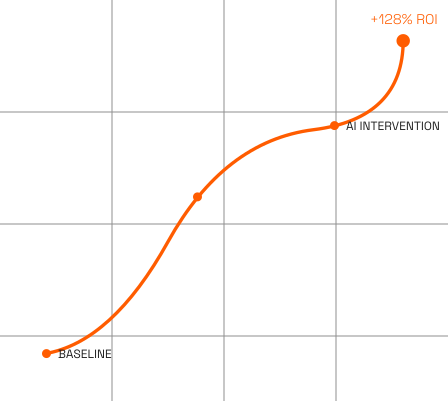
A mid-size retail group planned a three-year technology investment to modernize its e-commerce platform, replace the inventory management system, and add a new customer data platform. Once the business case and budget were approved, the program was set to begin.
What the roadmap review found:
Before starting, a roadmap review found dependencies between the three projects:
WE CHANGED THE ORDER
First, modernize e-commerce; second, launch the customer data platform once clean data was ready; third, update inventory management after the product data model was stable. This added 4 months to the timeline, but the original plan would have caused about 14 months of extra rework across all 3 projects.
MEASURABLE IMPACT
The team followed the new sequence without needing to change plans mid-way. All three projects finished on the updated timeline. The four-month extension cost much less than the fourteen months of rework the original plan would have caused. Mapping dependencies took three weeks and cost less than one percent of the total program budget.
Have a rough plan of technology transformation for your organization? We'll turn it into a step-by-step plan that we (or your internal technology team) can execute.
Book a Roadmap SessionA technology strategy gives your organisation its direction and purpose. Technology roadmap services take that direction and turn it into a step-by-step plan. This plan sets priorities, maps out dependencies, allocates resources, and connects each phase to business results. In short, the strategy shows where you want to go, and the roadmap explains how to get there, in what order, and at what cost.
Yes. At NeXus Labs, we always create a technology roadmap after completing Technology Transformation Consulting. The roadmap puts the consulting strategy into action. If you build a roadmap without a clear strategy, you end up with a list of activities but no real direction or meaningful results.
We create 12-month rolling roadmaps and review them every quarter or year, depending on how quickly things change in your business and technology. This timeframe provides sufficient visibility for planning and funding while keeping the plan up to date. For larger transformation programmes, we can extend the roadmap to support long-term investment planning.
Our governance framework defines how the organisation manages priority shifts, assigns decision ownership, outlines the update process, and clarifies the impact on downstream initiatives. Priority shifts managed through this framework keep the roadmap accurate. Informal changes outside the process can lead to inaccuracies.
We evaluate each initiative based on business impact, dependency readiness, and resource availability, making trade-offs between priorities clear before finalising the sequence. When all initiatives seem urgent, this framework identifies which deliver the most downstream value and which can be deferred without affecting the programme timeline.
Both options are possible. Some roadmaps address the entire technology estate, while others focus on a single domain, platform migration, system replacement, or digital channel investment. The scope is determined by the transformation strategy and is confirmed at the start of the engagement.
You should review your roadmap at least once a year. If your organisation is going through big changes or works in a fast-moving market, we recommend checking it every quarter. The right review cycle depends on how quickly things change. A roadmap that was accurate six months ago might need big updates after major shifts or changes in key dependencies. We set the review schedule in our governance framework at the start of our work together.

Resource and budget planning are built into the roadmap of the IT transformation services. Each phase includes what it needs, team capacity, outside resources, costs, and the time needed to secure them. If a roadmap doesn't show resource needs, the organisation can't act on it.

Business conditions change, and priorities shift. Technology options that didn't exist a year ago may now be important. A roadmap that isn't reviewed quickly becomes outdated. We include regular reviews so your roadmap always matches where your business is headed.

A 12-month rolling roadmap, reviewed every quarter, stays in sync with your business. If a roadmap is built once and never updated, it quickly becomes a problem. Our regular reviews keep your plan up to date as priorities change and new information comes in, ensuring it always aligns with your current direction.
Phase 03
We map out the dependencies between all projects, what each one needs from your technology and your team, and which steps must come first. We also identify risks that could cause delays and note what needs to be done before each stage can begin. Skipping this step in the digital technology transformation often leads to problems halfway through a project.

Phase 04
We prioritise projects based on business impact, readiness, and available resources, then organise them into a 12-month rolling plan that your team can actually deliver, instead of trying to do everything at once. We make trade-offs clear so leaders know how each decision affects the timeline.

Phase 05
We spell out what each phase needs, team capacity, external resources, costs, and lead times, and include this in the roadmap. This gives your finance team a clear plan, and leaders can commit to each phase knowing the costs and dependencies.

Phase 06
We create the roadmap in formats that suit everyone: a big-picture view for leaders, detailed phases for programme directors, and a resource view for finance. We also set up clear rules for how roadmap decisions are made, who updates it, when reviews happen, and how to handle shifting priorities.

Phase 07
For clients who want ongoing roadmap management, we run regular reviews to check what's been delivered, what's changed in your business or technology, and what needs updating in the roadmap. After each review, you get an updated plan for the next period.
Build scalable learning and administration platforms.
 Real Estate
We assess where AI reduces support costs, improves property management, and scales real estate operations.
 Healthcare
Clinical decision support, patient flow optimization, and medical image analysis solutions.