Loading service0%

Introduce AI across workflows and systems, without breaking what already works.
We integrate AI into your operations step by step, handling system integration, workflow redesign, and change management so your team actually uses what is deployed.
In 6-12 months, you'll have: An AI-mature organization running real use cases in production, teams that know how to work with AI rather than around it, and a clear operating model for how AI keeps improving your business over time.

An AI-mature organization running real use cases in production.

Teams that know how to work with AI rather than around it.

A clear operating model for how AI keeps improving your business over time.
You've identified where AI could help. You might have even run successful pilots. But scaling from proof of concept to operational reality is where most enterprise AI transformations stall.
Your systems weren't designed for AI integration. Data lives in disconnected silos. Workflows assume human decision-making at every step. And nobody has redesigned their processes to leverage AI's capabilities. They're just trying to automate broken workflows.
Teams don't know how to work with intelligent automation. Some resist it. Others expect magic. And nobody wants to be the one who breaks critical workflows trying to modernize them.
There's no AI adoption strategy. AI gets deployed, but no one's trained on when to trust it, when to override it, or how to handle exceptions. Without clear AI change management, teams either ignore the AI or become overly dependent on it.
You've identified where AI could help. You might have even run successful pilots. But scaling from proof of concept to operational reality is where most enterprise AI transformations stall.
Your systems weren't designed for AI integration. Data lives in disconnected silos. Workflows assume human decision-making at every step. And nobody has redesigned their processes to leverage AI's capabilities. They're just trying to automate broken workflows.
Teams don't know how to work with intelligent automation. Some resist it. Others expect magic. And nobody wants to be the one who breaks critical workflows trying to modernize them.
There's no AI adoption strategy. AI gets deployed, but no one's trained on when to trust it, when to override it, or how to handle exceptions. Without clear AI change management, teams either ignore the AI or become overly dependent on it.
The result? AI tools that get deployed but are underused.
Or worse: Workflows that are more complicated instead of simpler. And teams are frustrated because "transformation" made their jobs harder by turning business AI transformation into operational chaos.
[HOW WE LEAD AI TRANSFORMATION]
Before we design anything, four principles shape how we approach every organization-wide AI transformation:

Before introducing AI, we assess how your data flows, where data exchange breaks down, and which workflows need redesign. Layering AI over a dysfunctional process just accelerates AI implementation failure.

We've seen what happens when deployment moves faster than teams can adjust. The tools go live. Nobody uses them properly. Then, leadership calls it a failed initiative. We phase AI transformation consulting so each step has time to hold before the next one starts.
Organization-Wide AI Transformation

If the process AI would sit inside is broken, we say so before scoping anything. That's what separates honest AI transformation consulting from a vendor who just wants to deliver the build.

What's the point of a system that's live but unused? We define utilization targets before the engagement begins and track them throughout delivery, conducting a holistic AI maturity assessment.

Adoption of AI before involving people whose work is going to be transformed with AI, until after the organization has built and adopted the AI, is the perfect recipe for AI implementation failure. The Nexus AI adoption services involve them from day 1.
Our AI transformation services turn a complicated rollout into a process your team can actually follow:

Phase 01
We map your systems, data flows, and workflow dependencies to understand what AI can connect to today, what's in the way, and where the real risk sits. Not the ideal state, but the actual state. Everything else gets decided from here.

Phase 02
Before AI comes in, we rework the processes it will sit inside, where human judgment stays, where AI takes over, and how exceptions get handled. We do this with the people who actually run those workflows, not in a room full of consultants.

Phase 03
(Organization-Wide AI Transformation)
01
A map of your current systems, data architecture, and workflow structure. What's ready to connect to AI today? And, what needs work first? How should the build be sequenced and why?
Why It Exists:
Integration problems are cheap to fix before you start building. They're expensive to fix after. Most AI transformation consulting engagements that go over budget do so because this step was skipped or rushed.
Business Impact:
Leadership and technical teams agree on the actual scope before anyone commits resources to a timeline.
Risk Mitigation:
No surprises mid-deployment. The blockers are on paper before they become problems on the ground.
02
Process maps for every affected workflow. Where AI makes decisions, where humans stay in the loop, how exceptions get handled, and what the job actually looks like for the people doing it after the change.
Why It Exists:
You can deploy AI without changing the workflow around it. Teams will just keep doing things the old way. The technology runs. The behavior doesn't change. That's the most common AI adoption failure, and it's entirely avoidable.
Business Impact:
People know what their work will look like after the transformation, which is the only thing that actually reduces resistance.
Risk Mitigation:
Kills the "AI runs in parallel but nobody uses it" outcome before it starts.
03
A sequenced delivery plan outlines the scope, success criteria, dependencies, and what must be true before each stage can proceed.
Why It Exists:
Business AI transformation doesn't hold when everything gets built at once. Phasing means each step must prove itself before more is committed. It also means that leadership sees returns during the program, not just at the end.
Business Impact:
Momentum. Visible wins early. A program that builds confidence instead of burning it.
Risk Mitigation:
If something isn't working, the phase gate catches it before it scales.
04
Role-specific training and workflow guides for the people whose jobs actually change. Not a generic AI course. Not a one-hour briefing at launch.
Why It Exists:
People don't resist AI because they don't understand technology. They resist it because nobody showed them how their specific job gets better, or at least different in a way they can handle. AI change management that starts with "here's the new system" never works as well as one that started six weeks earlier.
Business Impact:
Utilization rates that match what the tool is actually capable of.
Risk Mitigation:
Avoids the single most predictable failure in any transformation program, which is unchanged behaviour after transformation.
05
Post-deployment tracking of utilization rates, workflow adherence, exception patterns, and team feedback. Measured against the targets set at the start, not against whatever feels reasonable at the end.
Why It Exists:
A transformation that looks good at go-live and quietly reverts within 60 days is not a success. Without a monitoring structure, there's no way to tell the difference until it's too late.
Business Impact:
Decisions about what to fix are based on what's actually happening, not on what was supposed to happen.
Risk Mitigation:
Adoption gaps surface while there's still time and budget to close them.
01
Full integration and readiness picture. Priority workflows redesigned. Teams are aligned on what's changing and what isn't, before it changes.
02
First use case live. Teams are trained and use the system—adoption data in. Phase two scope confirmed against what phase one actually showed.
03
Multiple AI use cases running across functions. Teams are managing outputs without us in the room. New opportunities are getting evaluated with organizational confidence rather than organizational anxiety.
You have tools in production. What's missing is the workflow redesign and team enablement that makes those tools actually get used. We begin the AI transformation project only after addressing the structural issues and constraints.
You've proven the concept in one context. Now you need to expand it across departments, regions, or product lines, with the integration architecture and change management to match that scope.

You own the outcome. You need AI transformation services structured around how your teams operate, with clear ownership, phased delivery, and adoption targets that tell you whether the change is holding.
We deliver specialized AI consulting across high-impact sectors:
 Industrial & Manufacturing
Predictive maintenance, quality control automation, and supply chain intelligence systems.
 Engineering & High-Tech
Enhancing innovation, performance, and efficiency through AI-driven engineering and automation.

A mid-size manufacturing company came to us wanting to automate production reporting. Field teams were logging output data manually. Managers were compiling it. The assumption was that automating the data collection step would fix the problem.
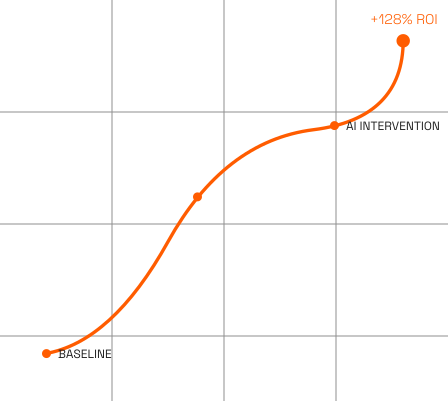
A mid-size manufacturing company came to us wanting to automate production reporting. Field teams were logging output data manually. Managers were compiling it. The assumption was that automating the data collection step would fix the problem.
What our integration assessment found:
We assessed their operations and mapped use cases for AI, and discovered:
OUR ACTION
Before any AI was introduced, we redesigned the reporting data model and standardized the input structure. Then we brought in an AI layer that generated draft management reports from those inputs.
MEASURABLE IMPACT
Report compilation dropped from 11.5 hours per manager per week to under 45 minutes. Leadership review cycles went from bi-weekly to weekly. The same headcount now covers 40% higher production volume, not because AI replaced anyone, but because we fixed the workflow before we introduced the technology.
If you're planning to scale AI across operations, let's assess your systems, workflows, and team readiness to develop a strategy for an AI-led transformation without business disruption.
Schedule a CallAI implementation is deploying a tool or use case. AI transformation changes how the organization works with AI (the structure, workflows, training, governance) so that deployment actually creates lasting change. Implementation is part of transformation. It's not the whole thing.
The readiness and integration assessment runs 3–4 weeks. Workflow redesign and phased planning take another 4–6 weeks. After that, implementation oversight varies; most enterprise AI transformation programs run 6–18 months, depending on the number of functions involved and the complexity of the integrations.
Most AI-led digital transformation programs work with the existing stack. The integration assessment assesses your current infrastructure to identify where AI can connect and where the gaps are. When something does need replacing, we identify exactly what and why before anyone commits to it.
Resistance usually means one of two things: the change wasn't explained in terms of how it affects their specific job, or they weren't involved until after the decisions were made. The AI change management approach brings affected teams in early, not to present a system to them, but to help design how their work will change. That's a different conversation, and it produces a different result.
We set adoption benchmarks before the program starts, such as utilization rates, workflow adherence, and handling of exceptions, and track them through delivery. The AI maturity assessment midway through tells us what's holding and what's not, while there's still time to fix it.
That's a decision made at the start, not at handover. Ownership structure, governance, and escalation paths are part of every AI transformation consulting engagement. The goal is a team that can manage, adapt, and extend the AI program without us. We build toward that from phase one.
That's where most programs start. Organization-wide AI transformation rarely means doing everything at once. We assess readiness by function and design a rollout that starts where the conditions are strongest, and builds organizational confidence before expanding scope into areas that need more groundwork.

By the time your teams see new workflows, they should already know why those workflows exist. AI change management that starts at launch is too late. The resistance is already there. Therefore, we start aligning your teams and systems.

Nexus AI is an AI adoption service that engages your team, your systems, and your servers (cloud or edge). Your team knows how the AI works, why decisions were made, and what to do when something breaks or needs to change.

Unlike SaaS AI tools, a true organization-wide AI transformation does not create a permanent dependency on an external team. Your team should know what the AI does, why it was built that way, and what to do when something needs to change.
Each phase has a clearly defined scope and success criteria that must be met before we proceed to the next one. It's also how enterprise AI transformation actually sticks.

Phase 04
We run role-specific sessions throughout the project. Teams need to understand how their work will change before it does. That's the difference between AI change management and an announcement.

Phase 05
After deployment, we track where teams are following the new workflows and where they're working around them. The engagement doesn't close until the numbers confirm the change has held.
Build scalable learning and administration platforms.
 Real Estate
We assess where AI reduces support costs, improves property management, and scales real estate operations.
 Healthcare
Clinical decision support, patient flow optimization, and medical image analysis solutions.