Loading service0%

Give your software the experience layer that makes people want to use it.
In UI and UX consulting service, we research user behavior, identify experience hurdles, and define a design strategy for your team.
In 45-60 days, you'll have: A research-backed UX design strategy, validated user journeys, and a clear design direction your development team can execute with confidence.
Overview
UI/UX consulting services at NeXus Build produce better outcomes when design strategies are grounded in user research. Before suggesting features, we learn from users instead of assuming, analyzing their motivations and goals for your solution.
In 45-60 days, you'll have a research-backed UX design strategy, validated user journeys, and a clear design direction your development team can execute with confidence.
The product works. Users aren't moving through it the way you expected. Sign-ups stall at a specific step. Purchases don't complete. Support tickets repeat the same questions. The software does what it was built to do, but the experience around it doesn't.
The interface was designed around how the team understands the product, not how a first-time user approaches it. No user journey mapping was done before development. What feels intuitive to the people who built it is invisible to the people using it.
Changes have been made, like simplified screens, shortened flows, and adjusted layouts, among others. Some things improved slightly. The core problem keeps reappearing in different places.
Individual screens aren't the issue. The user experience (UX) architecture underneath them is. Adjusting one screen without understanding the full journey moves the problem downstream. It surfaces in a different drop-off, a different support ticket, a different point of friction.
The product works. Users aren't moving through it the way you expected. Sign-ups stall at a specific step. Purchases don't complete. Support tickets repeat the same questions. The software does what it was built to do, but the experience around it doesn't.
The interface was designed around how the team understands the product, not how a first-time user approaches it. No user journey mapping was done before development. What feels intuitive to the people who built it is invisible to the people using it.
Changes have been made, like simplified screens, shortened flows, and adjusted layouts, among others. Some things improved slightly. The core problem keeps reappearing in different places.
Individual screens aren't the issue. The user experience (UX) architecture underneath them is. Adjusting one screen without understanding the full journey moves the problem downstream. It surfaces in a different drop-off, a different support ticket, a different point of friction.
The result? Development cycles are spent shipping changes that don't move the metrics they were built to move.
Even worse, if you launch a redesign that delivers the same results as before, because the UX research was never focused on identifying core issues.
[HOW WE THINK ABOUT UI/UX CONSULTING]
UI/UX consulting services at NeXus Build produce better outcomes when design strategies are grounded in user research. Before suggesting features, we learn from users instead of assuming, analyzing their motivations and goals for your solution. Four principles shape every UI UX design consulting engagement:

Every design recommendation (behavioural data, usability findings, and journey analysis) we make is grounded in UX research, and not in what looks good or what a competitor does. If we lack evidence, we don't recommend it.
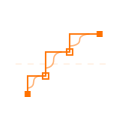
A single screen rarely causes user drop-off. The full sequence matters, be it the prior screen, its expectations, and missing information. Our user journey mapping integrates this to create a seamless user experience.

Some UX audit services start with assumptions and look to justify them. Instead, we let research guide our process so recommendations are rooted in user needs.
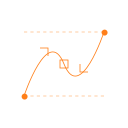
Screen-level reviews miss compounding friction across a multi-step flow. Our journey mapping traces the path (from entry to action), so we find where users lose momentum.
Most design feedback conflates UX and UI, leading to fixes that ignore the real issue. But with NeXus Build, UX research defines what to change first, and UX usability testing ensures it is done within the defined parameters.
Every UI UX design consulting follows the same research-to-strategy sequence:

Phase 01
We start by understanding your business objectives, the user outcomes you aim to achieve, and where the experience can improve. This discussion also reveals your team's user assumptions, which research will test.
Phase 02
We conduct a structured UX audit of your product. We review information architecture, navigation, flow, and interface consistency against usability principles. Each finding is documented with supporting evidence.
Phase 03
(And Why Each Deliverable Exists)
01
A structured review of your current product, which includes information architecture, navigation, flow completion, interface consistency, and usability considerations, with every finding documented and prioritised by business impact.
Why It Exists:
Teams iterating on UX without an audit are working from assumptions. UX audit services replace that assumption with evidence, so the next design or development cycle addresses the moments that actually affect how users move through the product.
Business Impact:
Product and development teams have a prioritised list of what to improve, why it matters, and what changing it is expected to move.
Risk Mitigation:
Ensures the next build cycle is directed by research rather than by what was most recently discussed in a product meeting.
02
Findings from task-based usability sessions with real users. Examining where they hesitated, where they took unintended paths, what they needed more of, and then combining them with behavioural analytics, showing how users actually move through your product.
Why It Exists:
Analytics show you where users slow down or exit. UX research services and usability testing show you why. One without the other leaves the most useful question unanswered.
Business Impact:
Design decisions are made based on evidence of real user behaviour, not on internal assumptions about how users think.
Risk Mitigation:
Ensures the design direction addresses what users actually need, not what the team assumed they needed.
03
Documented maps of the complete user experience across every stage: the path, decision points, friction moments, and the opportunities the current experience hasn't yet captured.
Why It Exists:
User journey mapping across the full product shows what screen-level reviews miss. Users don't respond to one screen in isolation. They respond to the cumulative experience of every step that came before it. A journey map makes that visible.
Business Impact:
Clarity on which improvements, made in which order, will produce the most meaningful change in how users complete the actions your product was built for.
Risk Mitigation:
Directs effort toward the most impactful moments in the journey rather than the most visually obvious ones.
04
A structured design brief covering experience architecture, user flow logic, information hierarchy, and interaction patterns with the rationale behind every decision, ready for your design and development teams to build from.
Why It Exists:
Development teams need more than wireframes. They need to understand the reasoning behind the structure so they can make consistent decisions as the build progresses. A UX design strategy document ensures the research intent carries through into the product.
Business Impact:
Design and development work from the same direction. Fewer revision cycles. Fewer decisions are made in isolation that work against the experience logic.
Risk Mitigation:
Ensures what gets built reflects what the research showed users need, and not what was easiest to design or fastest to develop.
01
UX audit complete. Usability testing done. Highest-impact opportunities are identified before a single design change is made. The product team aligned on what the research showed.
02
Full research findings delivered. User journey maps are complete. UX design strategy defined and handed over. Design and development teams working in the same direction.
03
Product changes built to the strategy are live. Experience metrics moving against the baseline set at audit. The second research cycle is scoped from what real usage is now showing.
You have shipped the build. Now you want your next changes to be based on evidence, not just hunches from meetings. UI/UX consulting gives your team the foundation to make better design decisions.

The best time to define user experience is before building. A UX design strategy set early helps your development team build the right experience from the start, not by revising after launch.

Your service is strong. Your innovative technology solutions should feel that way to every user who interacts with them. Digital experience consulting ensures the product aligns with user expectations, reinforcing your brand at every touchpoint.
We deliver specialized AI consulting across high-impact sectors:
 Industrial & Manufacturing
Predictive maintenance, quality control automation, and supply chain intelligence systems.
 Engineering & High-Tech
Enhancing innovation, performance, and efficiency through AI-driven engineering and automation.

A mid-size e-commerce retailer had been iterating on their checkout flow for two years. Drop-off at checkout sat consistently above 70%. Every previous round of changes had targeted the checkout screens, simplifying fields, reducing steps, and adjusting button placement. The number stayed where it was.
A mid-size e-commerce retailer had been iterating on their checkout flow for two years. Drop-off at checkout sat consistently above 70%. Every previous round of changes had targeted the checkout screens, simplifying fields, reducing steps, and adjusting button placement. The number stayed where it was.
What our UX audit and usability testing found:
Every previous change had targeted the checkout screens. The audit found the real issue was upstream:
WE DIDN'T TOUCH THE CHECKOUT
We restructured the returns policy into plain language, added a one-line summary to the product detail page, and surfaced it again at cart review.
MEASURABLE IMPACT
Checkout drop-off dropped from 71% to 43% within 6 weeks, and 28% of previously incomplete purchases were recovered, without a single change to the checkout flow. Two years of checkout iteration hadn't moved the number. Six weeks of research identified what the iteration had been missing the entire time.
We'll map what the experience is doing well, where it has room to do more, and what the research says should change.
Book a UX AuditUI/UX consulting services define what the experience needs to do: research, audit, journey mapping, and strategy. Design consulting executes that direction. Consulting comes first because it gives design a brief grounded in user behaviour rather than assumptions. NeXus Build offers both, in the right sequence.
Not always. UX design strategy is just as valuable before a product is built as after. If you're going into development with a concept defined, we can map user journeys, validate the flow logic with real users, and produce a design strategy your development team can build from before a line of code is written.
A structured review of your product's information architecture, navigation, user flows, interface consistency, and usability considerations. Every finding is documented with the evidence behind it and prioritised by its likely impact on how users move through the product. UX audit services typically take 1-2 weeks, depending on product scope.
Analytics show you where users slow down or exit. UX research services and usability testing show you why. A notable drop-off at a specific step could mean several different things. The analytics identify that something is happening, and research tells you what's driving it. Both together give you findings you can act on with confidence.
A standalone UX audit runs 1-2 weeks. Comprehensive research, journey mapping, and UX design strategy typically run 4-8 weeks, depending on product scope. We confirm the timeline after an initial discovery conversation; scope determines timeline, and we won't estimate one before we understand the other.
Yes. Every deliverable (audit findings, journey maps, UX design strategy) is structured for handover to internal or external teams. We work alongside your team, not instead of them. The research and strategy are ours. The execution stays with whoever you have in place.
It sits at the start. UI UX design consulting defines the experience direction before Design Consulting executes it, and Software Product Development builds it. You can engage us at any stage, but the earlier the research is conducted, the more confidently subsequent decisions are made. Software technology solutions built on a defined UX strategy ship with fewer revisions and perform more strongly from day one.

After the mapping, the UX design strategy defines the structure, flow, and logic before a single screen is touched. UI design direction without that foundation produces interfaces that look polished but underperform what they could. It's UI/UX because the UI sits atop a deeper UX foundation.

A UX audit that leads to an untouched report is not valuable. We prioritize findings by impact, write in straightforward language, and link each finding to actionable next steps for your product and development teams, continuing every design iteration until you achieve a seamless product experience.
We structure every UX research report so your team can act on it. It is prioritized, written plainly, and tied to clear recommendations.
We run UX usability tests with real users. These are task-based and show where users hesitate, stray, or need more support. Combined with analytics, this phase refines or confirms our assumptions.
Phase 04
We map the full experience, including entry, onboarding, core use, and return. We look for moments that slow users down or create doubt. This user journey mapping shows which improvements, in what order, have the biggest impact.
Phase 05
We turn findings into a structured UX design strategy. It defines experience architecture, flow, hierarchy, and interaction patterns based on research. This document guides your design and development teams.
Build scalable learning and administration platforms.
 Real Estate
We assess where AI reduces support costs, improves property management, and scales real estate operations.
 Healthcare
Clinical decision support, patient flow optimization, and medical image analysis solutions.